There is a moment many San Jose drivers experience on a blazing summer afternoon when they slide into their car after it has been sitting in a parking lot for two hours and immediately wonder why they are paying so much in gas and electricity to run an air conditioner that is fighting a losing battle against their own windows.
Thank you for reading this post, don't forget to subscribe!Standard glass lets solar energy pour in with almost no resistance. The car turns into an oven, the dashboard cracks over years of UV exposure, and the driver squints the entire commute home. The solution a growing number of people are turning to is nano-ceramic window tint, and it works in a fundamentally different way than anything that came before it.
Most people have heard of window tint, but nano-ceramic specifically is a term that raises questions. What does nano-ceramic actually mean? Is it just a marketing word for expensive film, or is there real science behind it? How does it differ from regular ceramic film or other film types? This guide answers all of those questions clearly and honestly, so you know exactly what you are getting and why it matters.
The Science Behind Nano-Ceramic Technology, Explained Simply
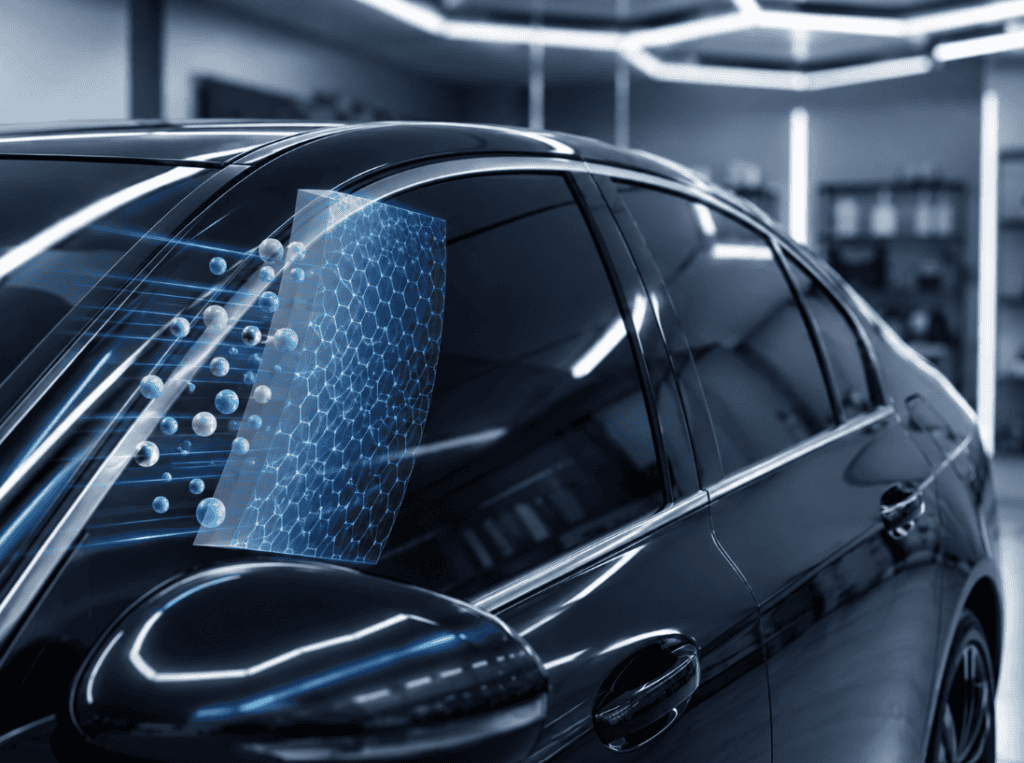
The word nano refers to scale. One nanometer is one billionth of a meter. Particles at this scale are so small they cannot be seen under a standard microscope and behave differently than the same material in larger form. In nano-ceramic window film, ceramic particles at this nanoscale are suspended within the film’s polymer layers. The resulting structure can interact with specific wavelengths of light and solar energy in ways that larger particles simply cannot replicate.
Ceramic itself is not a new material. It has been used in electronics, aerospace, and industrial applications for decades because of its stability, heat resistance, and non-conductive properties. When ceramic is reduced to nanoscale particles and embedded in a thin film matrix, it gains the ability to selectively block infrared radiation and UV rays while remaining highly transparent to visible light. This selectivity is what makes nano-ceramic film special. It is not just blocking light by being dark. It is filtering out the specific wavelengths of solar energy that cause heat and damage while letting the wavelengths you actually want, the visible light that lets you see and brightens your spaces, pass through freely.
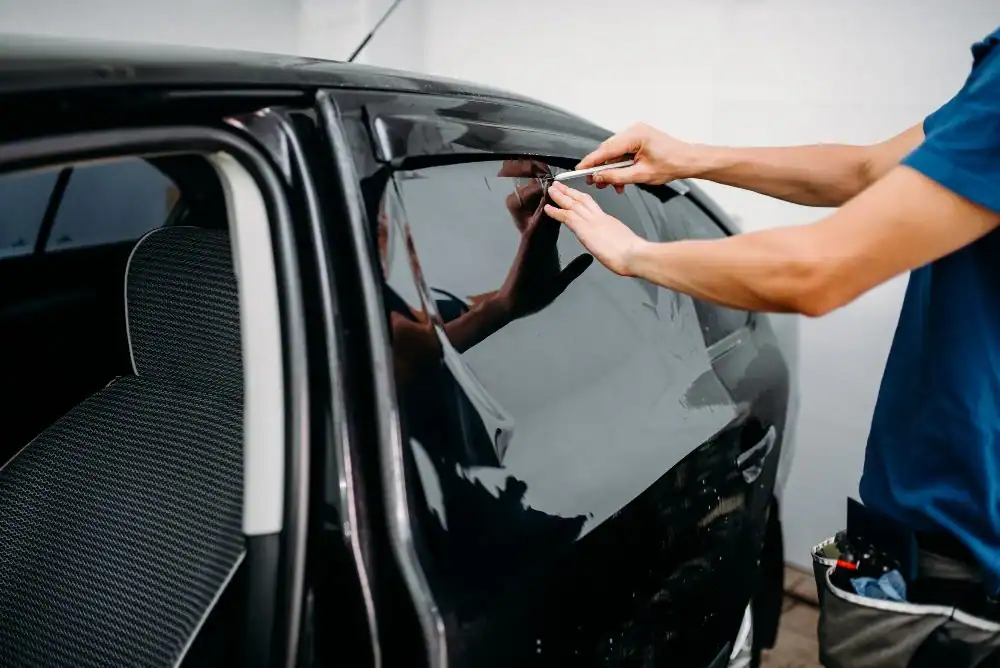
Traditional window tinting approaches work differently. Dyed films absorb light using color pigments that degrade over time. Metalized films reflect solar energy using metal particles, which works but interferes with electronic signals. Standard ceramic films use ceramic compounds but not necessarily at the nanoscale, which limits how precisely the film can be engineered to target specific wavelengths. Nano-ceramic technology represents a more refined version of ceramic film where the particle size itself is part of the performance equation. Smaller particles mean more surface area relative to volume, which translates to more interaction with incoming solar energy per unit of film material.
The practical result of this engineering is a film that blocks more heat per unit of visible light blocked than any other film type. You can have a nearly clear nano-ceramic film that rejects 80 percent or more of infrared heat while letting 70 percent or more of visible light through. That combination is not achievable with dyed or metalized films, and it is only partially achievable with standard ceramic technology. For San Jose window tinting applications where maintaining visibility and natural light matters as much as comfort, this performance profile is genuinely difficult to match.
What Nano-Ceramic Film Delivers in Real Daily Use
Understanding the technology is useful, but what most people actually care about is what they will experience day to day after nano-ceramic film goes on their car, home, or business. The benefits translate directly into things you feel, see, and measure on your utility bills.
Heat rejection is the most immediately noticeable benefit. Nano-ceramic film targets infrared radiation with high precision, and infrared is what heats up the interior of a car or a room. A vehicle with nano-ceramic film on all windows can maintain interior temperatures that are dramatically lower than an untreated vehicle sitting in the same conditions. The difference during San Jose summers, which bring sustained heat and intense direct sun, is significant.
Drivers report that their cars feel cooler to get into, their air conditioning reaches a comfortable temperature faster, and they spend less fuel maintaining that temperature on long drives. For homeowners, rooms that used to build up uncomfortable heat near west or south-facing windows feel noticeably more livable throughout the afternoon.
UV protection is where nano-ceramic film matches or exceeds every other film type on the market. The best UV protection window tint for homes and vehicles blocks 99 percent or more of both UVA and UVB radiation. Nano-ceramic films consistently hit this benchmark because UV blocking is built into the film’s interaction with the solar spectrum at the particle level, not achieved through darkness or dye. This protection works for skin, which matters for drivers who accumulate years of UV exposure through side windows during daily commutes, and for interiors, where UV rays cause fading, cracking, and discoloration of every surface they touch repeatedly over time.

Glare reduction is another practical benefit that improves daily life in ways people appreciate more than they expected. Glare reduction window film at the nano-ceramic level filters incoming light intensity without dramatically changing how bright a room or vehicle interior feels. The harsh, eye-straining quality of direct sun through glass is reduced while the pleasant, natural quality of ambient daylight is largely preserved. Drivers notice this on morning and evening commutes when the sun is at a low angle and glare would otherwise require constant squinting. Homeowners notice it near windows where computer screens or televisions used to be washed out during certain hours.
Signal transparency is a practical advantage that sets nano-ceramic apart from metalized films specifically. Because nano-ceramic particles are non-conductive and non-metallic, they do not interfere with radio waves, GPS signals, cellular reception, satellite radio, or any other wireless technology that depends on signals passing through glass. For modern vehicles loaded with connectivity features, and for commercial buildings where wireless infrastructure is part of daily operations, this matters. Metalized films create measurable signal interference that ranges from mildly annoying to genuinely problematic depending on the application. Nano-ceramic eliminates this issue entirely.
Longevity is perhaps the most financially important benefit over time. Nano-ceramic films do not fade, shift color, or degrade in performance the way dyed films do. The ceramic particles at the nano level are chemically stable and resistant to UV-induced breakdown. A quality nano-ceramic film installed by top window tint specialists in San Jose will look and perform at essentially the same level in year ten as it did in year one, provided it is cleaned and maintained correctly. This long lifespan changes the total cost calculation significantly. A more expensive film that lasts fifteen years costs less over time than a budget film replaced every five.
Choosing Nano-Ceramic Film for Your Car, Home, or Business
Not every installer carries genuine nano-ceramic film, and not every film marketed with that label meets the performance standard the name implies. This is a real issue in the window film market. Some products use the term loosely to describe any film with some ceramic content, regardless of particle size or engineering quality. Knowing what questions to ask protects you from paying nano-ceramic prices for standard ceramic or even metalized film performance.
Ask the installer for the specific product name and manufacturer. Reputable nano-ceramic films come from established manufacturers who publish verified specifications, including infrared rejection rates at specific wavelengths, total solar energy rejected, UV rejection percentages, and visible light transmission data. Request these figures and compare them against what premium performance looks like. An infrared rejection rate of 95 percent or higher at key wavelengths and a TSER above 60 percent are benchmarks that distinguish genuine high-performance nano-ceramic film from products that borrow the terminology without delivering the results.
For automotive applications, nano-ceramic film paired with a professional installation from an experienced San Jose tint shop gives you the best combination of performance, durability, and legal compliance. California tinting laws require front side windows to allow at least 70 percent visible light transmission. Quality nano-ceramic products achieve strong heat and UV protection while staying within this requirement because the film’s performance comes from its particle engineering, not from its darkness.
For residential window tinting and energy efficient commercial window tinting, nano-ceramic film in lighter shades allows businesses and homeowners to maintain a bright, open environment while cutting solar heat gain substantially. Dr. Tint California Window Tinting works with both residential and commercial clients throughout San Jose to match the right nano-ceramic product to each specific situation based on window orientation, performance goals, and budget.
Nano-ceramic window tint is not just the most advanced film type available today. It is the one that most completely solves the problems people actually experience with unprotected glass, from unbearable heat in parked cars to UV-damaged furniture and persistent glare on screens. When you are ready to invest in window film that performs at the highest level and lasts for years, nano-ceramic technology from Dr. Tint California Window Tinting is where that conversation starts.
Related Post